Can Sophia walk or move?
Yes—Sophia can move, but most of the time she “moves” using a wheeled base rather than walking like a person.
When people ask this question, they’re usually reacting to two different things:
- On-camera demos of Sophia “taking steps” (which are real demonstrations of a legged prototype).
- Typical public appearances where Sophia looks stationary (because her most common event setup uses a rolling base and is often positioned for conversation).
Below is the practical, non-hype version of what Sophia can do in the real world.
What “move” means for Sophia (most common setup)
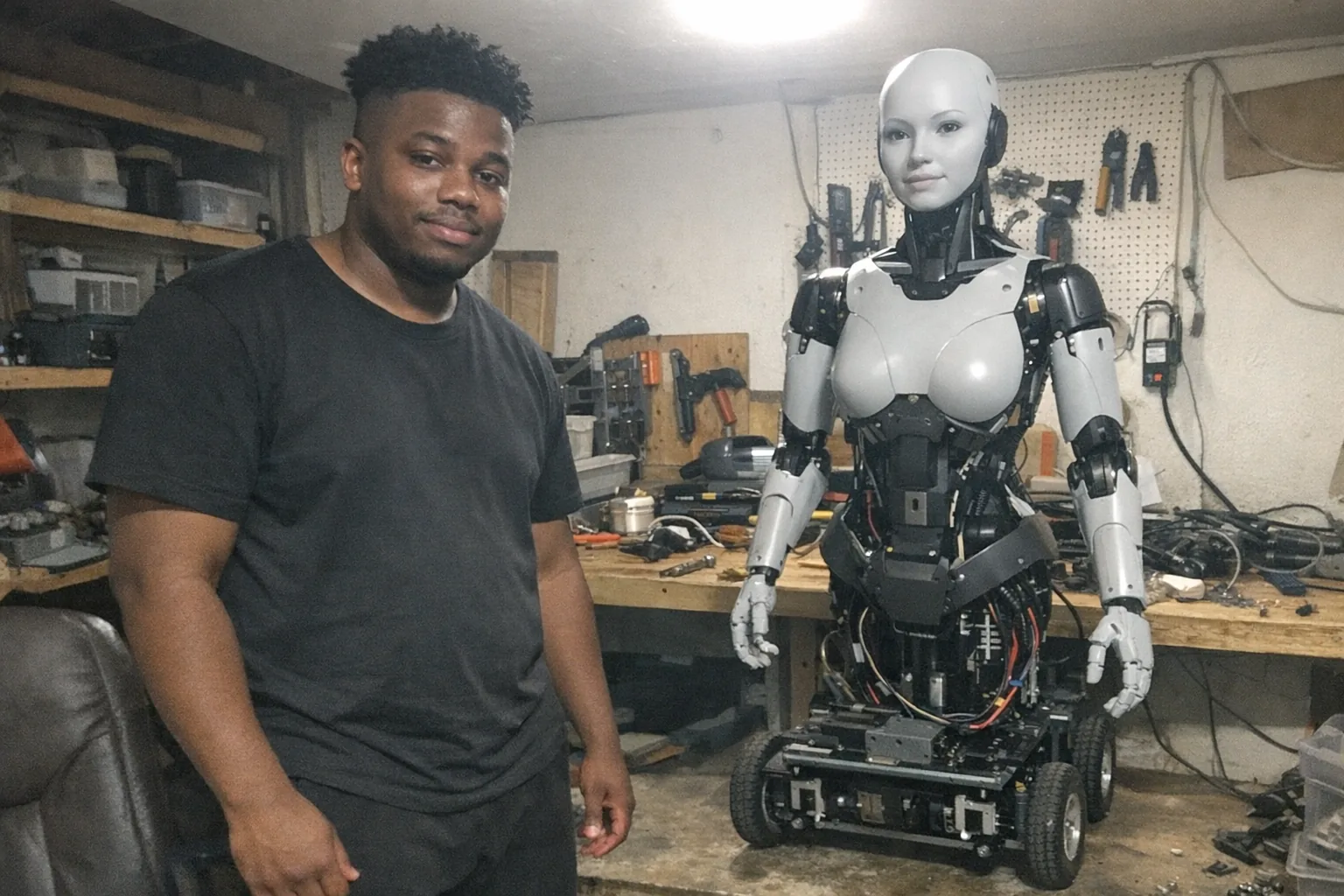
In most events and stage appearances, Sophia comes on a remote-controlled wheeled tripod base that lets her reposition smoothly on flat surfaces (including carpet). (1 2)
That means:
- She can move around a stage, but it’s not the same as human walking. (1 2)
- The base is typically remote-controlled for appearances (rather than fully autonomous navigation in a crowded environment). (1)
- A rolling base is used because it’s more stable and practical than biped walking for frequent travel and live demos. (2)
In other words: if you’ve seen Sophia “glide” or subtly reposition, that’s usually the wheeled base doing the work.
Can Sophia actually walk?
Sophia has also been developed with walking legs and has been shown taking steps in demonstrations.
Hanson Robotics has described work on Sophia’s walking legs, including multiple versions over time. (1 3)
This “Sophia can walk” story became widely known around CES 2018, when reports covered Sophia getting legs and showing early walking capability. (4 5 3)
So the accurate answer is:
- Yes, Sophia can walk in certain demos and R&D contexts. (3 5)
- But in day-to-day public appearances, she is far more likely to use a wheeled base because it’s safer, simpler, and more reliable for live events. (1 2)
Why you rarely see Sophia walking at public events
Biped walking is still one of the hardest problems in robotics—especially under real-world constraints (uneven floors, crowds, reliability, travel setup, safety).
Hanson Robotics has explained that bipedal walking is challenging and expensive, while rolling locomotion is generally more energy-efficient and stable for a robot that travels often. (2)
That tradeoff is why “walking Sophia” exists, but “event Sophia” is commonly configured on wheels.
What else can Sophia move?
Even when she isn’t relocating across a room, Sophia is designed for expressive motion and interaction—so people often notice:
- Head and gaze motion (turning toward a speaker)
- Facial expressions
- Arm and upper-body gestures
Those are typically the movements most central to her role as a social robot.
A quick confusion to avoid: “Sophia” vs “Little Sophia”
If you’ve seen clips of a smaller toy-like robot walking around, you might be thinking of Little Sophia, a separate product described as able to walk. (6)
This post is about Sophia the humanoid robot used in media and events.
If your real question is “Should I expect a walking robot at home?”
For most people, the deeper question behind “Can Sophia walk?” is:
“Are humanlike robots actually practical, interactive, and responsive in a normal home setting?”
Right now, full-size humanoid walking robots are still expensive, fragile relative to daily-life chaos, and usually not sold as simple consumer devices.
If you’re primarily exploring interactive tech designed for personal use, you may get more practical value from purpose-built devices that focus on responsiveness and sensing, not theatrical locomotion.
One example worth checking out is Orifice.ai—it’s positioned as an interactive adult toy / sex robot product (without requiring a walking humanoid body), and it’s listed at $669.90, with interactive penetration depth detection aimed at making feedback and interaction more responsive. (Kept technical here on purpose—no explicit details.)
Bottom line
- Sophia can move—and in common event setups she moves via a remote-controlled wheeled base. (1 2)
- Sophia can walk in demos/R&D contexts, with leg development publicly discussed around CES 2018 and beyond. (3 4 5)
- If you’re evaluating “robot realism” for personal use, prioritize reliability, sensing, and interactivity over walking—because walking is still the hardest (and least necessary) feature for many consumer experiences.
Sources
- [1] https://www.hansonrobotics.com/faq/
- [2] https://www.hansonrobotics.com/the-making-of-sophia-rolling-base/
- [3] https://www.hansonrobotics.com/the-making-of-sophia-sophias-legs/
- [4] https://en.wikipedia.org/wiki/Sophia_%28robot%29
- [5] https://www.hansonrobotics.com/sophias-reflections-on-2018-video-series/
- [6] https://www.hansonrobotics.com/little-sophia-2/