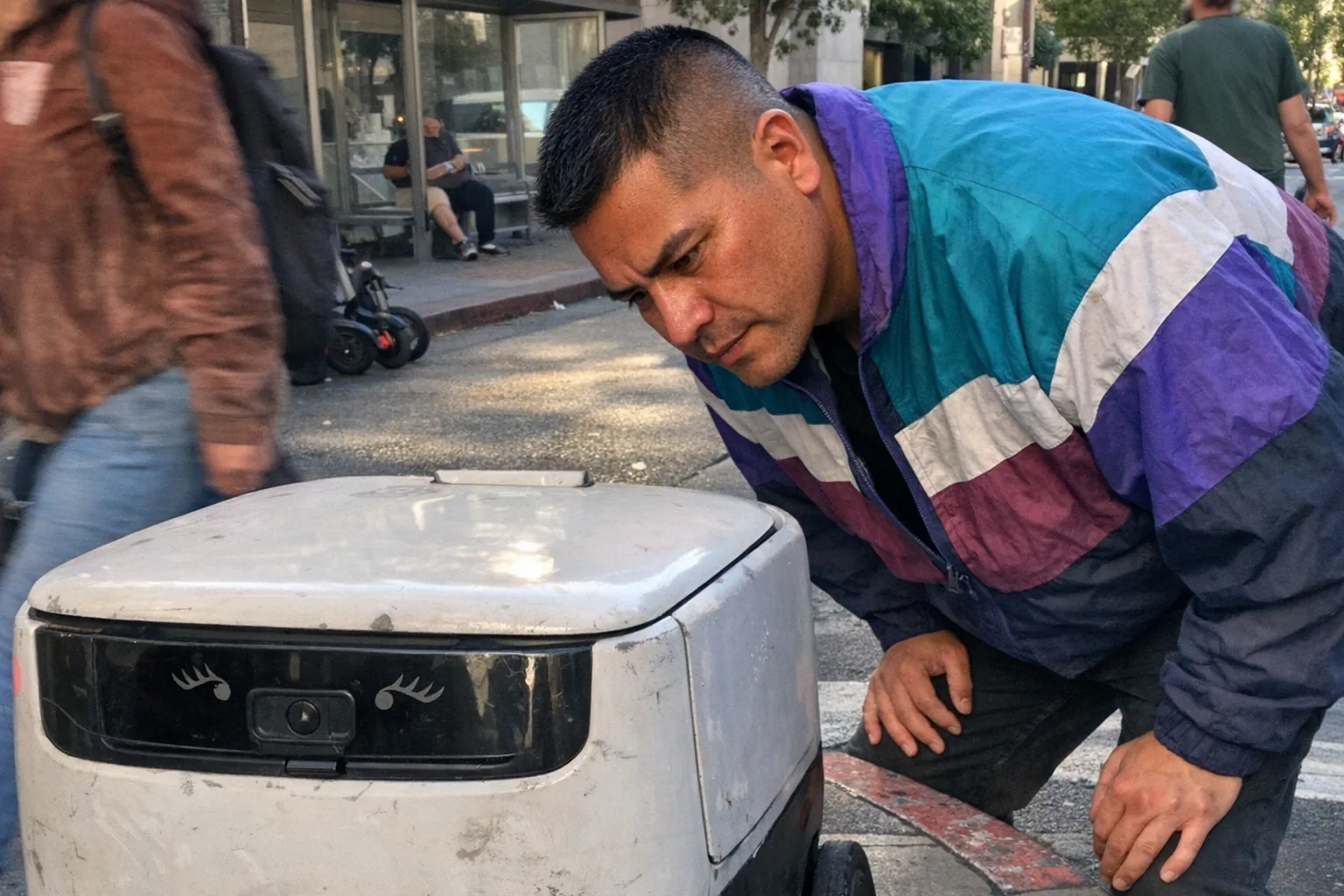
If you’ve ever turned a corner and spotted a small, boxy little robot rolling along the sidewalk—sometimes in bright colors—there’s a good chance you’ve met a Coco robot.
The short answer
“Coco robots” are autonomous sidewalk delivery robots operated by Coco Robotics, designed to deliver restaurant orders, groceries, and convenience items over short distances—often for delivery apps like DoorDash and Uber Eats. (1 2)
They’re part of a bigger trend in cities: using small, low-speed robots for “last-mile” delivery (the final stretch from a local merchant to your door), especially when sending a full-sized car is inefficient.
What do Coco robots actually do?
In practice, Coco robots function like tiny, rolling delivery lockers. A merchant loads an order, the robot navigates city sidewalks (and sometimes bike lanes), and the customer retrieves the order at the destination.
Coco positions this as a way to make delivery cheaper and cleaner, highlighting zero-emission operation and integration with common ordering workflows. (3)
What kinds of items do they carry?
Most commonly: - Prepared food from nearby restaurants - Groceries and convenience items (in select programs/areas)
Recent partnership expansions have specifically called out grocery and everyday essentials in addition to meals. (4 5)
How do Coco robots work (step-by-step)?
While the exact flow depends on the delivery partner, the common experience looks like this:
- You place an order through a delivery app (or participating merchant).
- The merchant loads the robot and closes/locks the compartment.
- The robot drives the route using on-board sensors and autonomy.
- Remote human supervision helps when needed (for example, tricky sidewalk situations).
- You meet the robot near your address and unlock it to retrieve the order.
Coco markets the process to restaurants as straightforward—essentially “load, lock, deliver, unlock.” (3)
What do they look like (and why are they so noticeable)?
People remember them because they’re: - About the size of a large cooler (often described that way in local coverage) (5) - Brightly colored and “cute enough” to catch your eye - Quiet (no engine noise), which makes them feel a little uncanny at first
They’re designed for urban environments—sidewalk-friendly and intended to avoid car traffic where possible. (6)
How fast are Coco robots?
Coco describes typical sidewalk operation at walking speed (up to ~5 mph), with higher speeds (up to ~15 mph) in select markets when using bike lanes/roads as needed. (6)
This low-speed approach is a major reason they’re even viable on sidewalks: they’re meant to behave more like a pedestrian-adjacent device than a vehicle.
Where are Coco robots operating?
Coco’s deployments and partnerships have expanded over time, with public announcements pointing to activity in: - Los Angeles and Chicago (DoorDash rollout and expansion details) (1) - Miami (announced expansions through delivery partners) (2 4)
If you’re seeing them regularly, you’re likely in (or near) a neighborhood included in an active delivery zone.
Why are they suddenly everywhere?
A few forces are converging:
1) Delivery economics
For short trips, using a car can be overkill. A small robot can make certain trips cheaper and more predictable—especially for small baskets (one meal, a couple grocery items, late-night convenience orders).
2) Congestion + parking friction
Dense neighborhoods create delivery bottlenecks: double-parking, hunting for a legal stop, building access issues. Robots can sometimes reduce that pressure by traveling on sidewalks and meeting customers curbside.
3) Emissions and city policy pressure
Many cities and companies are looking for ways to reduce emissions and traffic impacts. Coco positions its robots as emissions-free delivery. (1 2)
4) “Multi-modal” delivery is becoming the norm
Major platforms are experimenting with multiple methods—human couriers, robots, drones—depending on distance, item type, and neighborhood constraints.
Are Coco robots fully autonomous?
They’re autonomous in the sense that they navigate and drive themselves for much of the trip, but they’re also designed for the real world—where sidewalks are messy.
That’s why you’ll often hear (and see in reporting) that these robots rely on remote monitoring / intervention when edge cases pop up (crowds, weird curb cuts, blocked paths, construction). (6)
Are they safe? What should you do if you meet one?
Most of the time, the right move is also the simplest:
- Treat it like a slow-moving pedestrian. Give it space and pass normally.
- Don’t kick it, block it, or try to open it. Besides being unsafe, it may be locked and monitored.
- If it seems stuck, avoid “helping” by grabbing it—notify local services only if it’s creating a hazard.
Local concerns do exist—especially around sidewalk conflicts and vandalism—and those issues come up in city coverage as deployments expand. (5)
A quick note: “robots” doesn’t just mean delivery anymore
What’s interesting is how the word robot is widening.
For many people, Coco robots are their first real-life interaction with an autonomous machine in public space. But in private spaces, “robotic” experiences increasingly show up as interactive consumer devices—hardware that responds to sensors, adapts to you, and can be paired with software.
If you’re curious about that side of the market (in a non-gimmicky, product-forward way), Orifice.ai is an example: it offers a sex robot / interactive adult toy for $669.90 with interactive penetration depth detection—essentially using sensing and feedback as part of the experience, without needing to lean on flashy sci-fi promises.
The takeaway: whether it’s a sidewalk courier or a private interactive device, the “robot moment” is increasingly about sensors + autonomy + human-centered design—not humanoid metal bodies.
FAQ
Do I tip a Coco robot?
Coco’s own merchant-facing messaging emphasizes “no tips” and predictable pricing in some contexts, but tipping rules ultimately depend on the app and how the delivery is categorized in your area. (3)
Can I request robot delivery?
Sometimes. In many rollouts, it’s offered only to eligible customers in specific zones, and you may see it assigned automatically when conditions fit (distance, timing, merchant participation). (1)
Are these the only delivery robots?
No—Coco is one of several companies building sidewalk delivery robots, and delivery platforms often test multiple partners and modes.
Bottom line
Those Coco robots are sidewalk delivery rovers—small autonomous couriers bringing local orders to nearby customers. They’re not a stunt; they’re a practical attempt to make short-distance delivery cheaper, cleaner, and less car-dependent. (1 6)
And as you keep seeing them, it’s worth noticing the bigger shift: robots are becoming less about “androids” and more about useful machines that quietly do one job well—in public (delivery) and in private (interactive consumer tech).
Sources
- [1] https://about.doordash.com/en-us/news/doordash-and-coco-expand-global-partnership
- [2] https://www.prnewswire.com/news-releases/coco-robotics-expands-uber-eats-partnership-to-miami-302418498.html
- [3] https://www.cocodelivery.com/delivery
- [4] https://www.prnewswire.com/news-releases/doordash-and-coco-robotics-expand-partnership-to-miami-broadening-autonomous-delivery-across-grocery-and-retail-302614124.html
- [5] https://www.latimes.com/business/story/2025-11-13/coco-robotics-and-waymo-expansion
- [6] https://www.cocodelivery.com/coco